
Master Your $tory First
If you are going to study storytelling, start by mastering the first and still the best structure.

People love talking about the mechanics of storytelling.
They’ll discuss the Hero’s Journey, three-act structure, in medias res, story arcs, and whatever narrative framework is currently in fashion.
Yet they often overlook the oldest, most influential story structure ever told.
The one that shaped Western civilization.
The one that has been copied more than any other.
The Bible’s story structure.
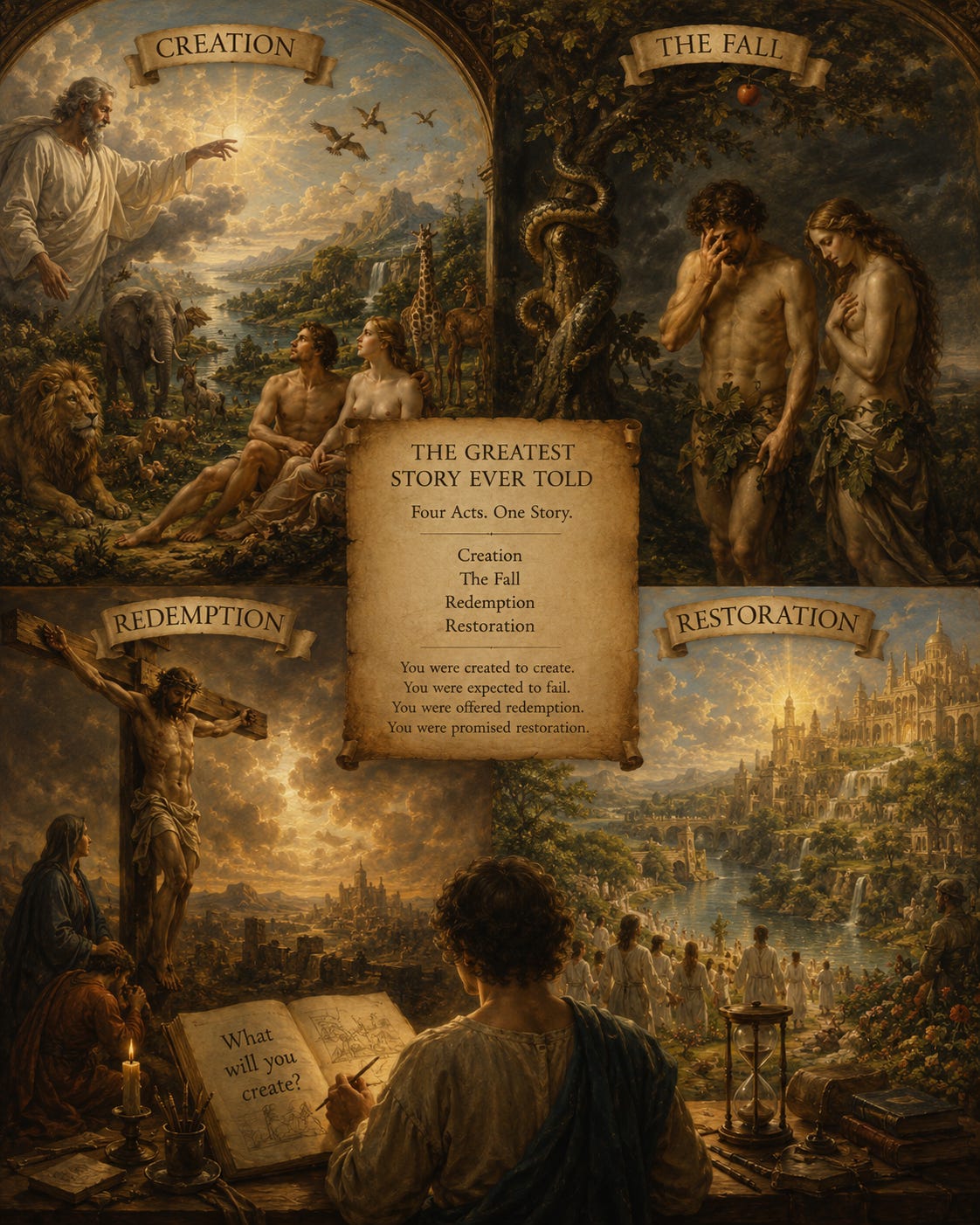
Creation.
The Fall.
Redemption.
Restoration.
Four acts.
One story.
Let’s apply it to something as simple as a job interview.
Imagine an employer says:
“Your job is to create.
Create products. Create solutions. Create experiences. Create relationships that customers will never forget.
I’m giving you tremendous freedom. In fact, I’ll let you decide what to create.
But there’s a catch.
You must try so hard, reach so far, and attempt things so ambitious that you inevitably fail.
If I never see you fail, I’ll assume you’re playing it safe, and I’ll fire you.
Failure isn’t evidence that you’re unqualified. It’s evidence that you’re creating.
And here’s the best part.
As long as you’re genuinely trying, you’ll never lose your job.
Every mistake will be forgiven.
Every setback will become part of your growth.
You’ll have security, grace, and another chance tomorrow.
And no matter how difficult the journey becomes, I promise you this:
The story ends well.
In the end, you’ll be fulfilled, restored, and glad you took the risk.”
Would you take that job?
Most people would accept it immediately.
But here’s the surprising truth.
You already have that job.
The biblical story isn’t merely a religious idea. It’s a framework for human flourishing.
You were created to create.
You were expected to fall.
You were offered redemption.
And you were promised restoration.
Perhaps that’s why this story has endured for thousands of years. It reflects something deeply true about the human condition.
So here’s a question worth journaling about:
What would you create if you knew that failure was not the end of your story?
What would you attempt if you knew grace was available?
What would you build if you knew restoration was waiting on the other side of your mistakes?
Write down your answer.
Because discovering what you would create under those conditions may be the first step toward understanding what it means to “live the story” that truly ends, happily ever after.